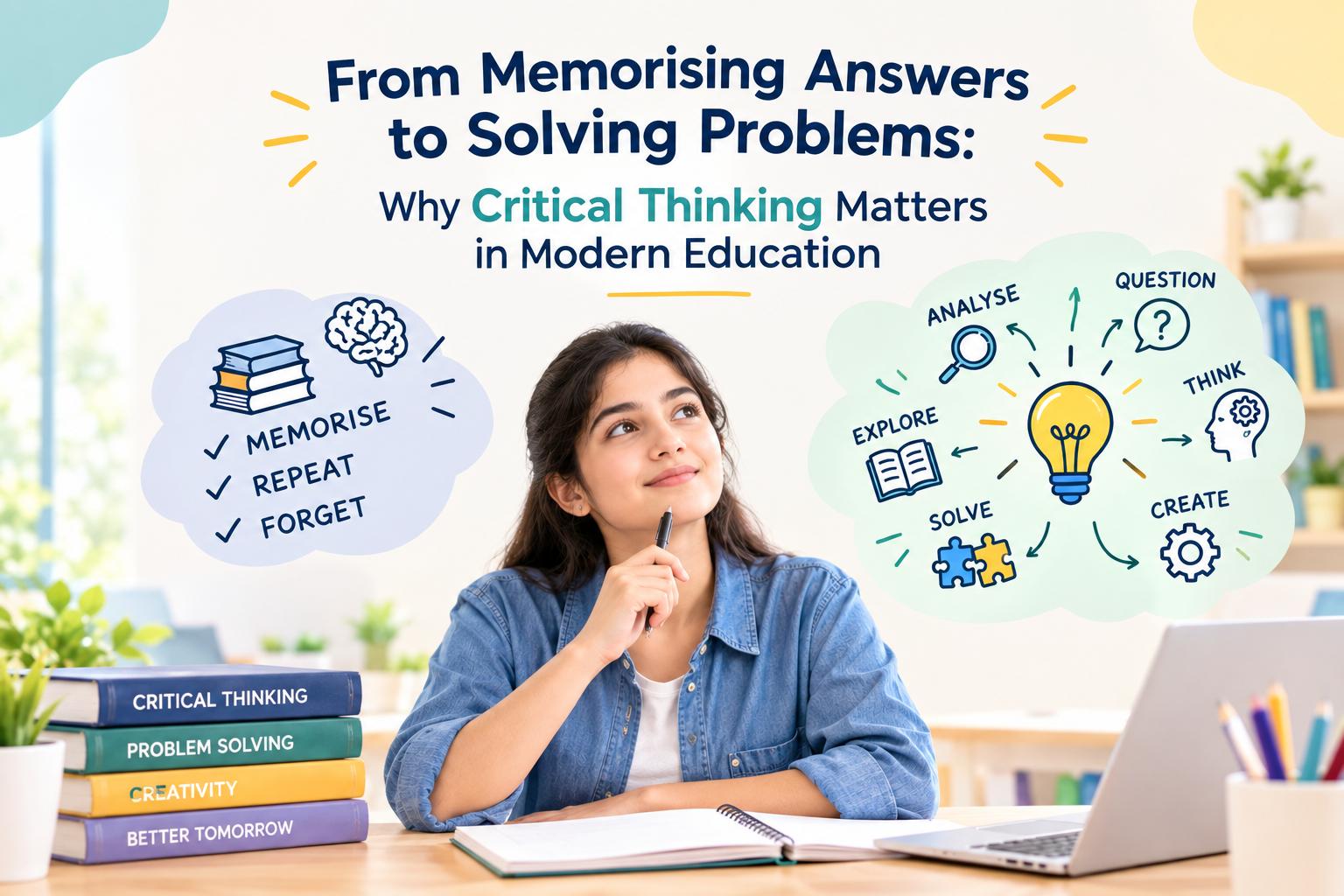
Education is no longer just about remembering information and writing the correct answers in an examination. In today's rapidly changing world, students need to understand concepts, ask questions, analyse situations and find solutions to real-life problems.
This is where critical thinking becomes an important part of modern education. Instead of simply memorising answers, students learn how to think independently, make informed decisions and approach challenges with confidence.
What Is Critical Thinking?
Critical thinking is the ability to carefully analyse information, ask meaningful questions, understand different perspectives and reach logical conclusions.
For students, it means going beyond the question “What is the answer?” and learning to ask:
Why is this the answer?
How does this work?
Is there another way to solve the problem?
What evidence supports this idea?
How can I apply this knowledge in real life?
These questions encourage students to become active learners rather than passive receivers of information.
Why Is Critical Thinking Important for Students?
1. Helps Students Solve Problems
Students face different types of challenges in academics and everyday life. Critical thinking teaches them to break a problem into smaller parts, understand it and explore possible solutions.
This skill is useful not only in mathematics and science but also in languages, social studies and everyday situations.
2. Encourages Independent Learning
Memorisation often depends on remembering information provided by someone else. Critical thinking encourages students to explore, question and discover information on their own.
This develops curiosity and makes learning more meaningful.
3. Improves Decision-Making
Students make decisions every day. Learning to compare information, understand consequences and evaluate different options helps them make thoughtful decisions.
This skill becomes increasingly valuable as students grow academically and personally.
4. Builds Creativity
Critical thinking and creativity work together. When students are encouraged to look at a problem from different angles, they can discover new ideas and approaches.
Classroom activities such as brainstorming, discussions, projects and open-ended questions can help develop this ability.
5. Prepares Students for the Future
The modern workplace requires more than academic knowledge. Employers increasingly value skills such as problem-solving, communication, adaptability, creativity and decision-making.
Developing critical thinking during school years can help students become better prepared for future academic and professional challenges.
Memorisation vs Understanding
Memorising information still has its place in education. Students need to remember basic facts, formulas, vocabulary and important concepts.
However, memorisation becomes more useful when it is combined with understanding.
For example, instead of only memorising a science formula, students can learn what the formula means, why it works and where it can be applied.
Memorisation helps students remember. Understanding helps them apply. Critical thinking helps them solve.
How Schools Can Develop Critical Thinking Skills
Schools can encourage critical thinking through simple changes in classroom learning:
Encourage students to ask questions.
Use real-life examples while teaching concepts.
Give students problem-solving activities.
Encourage classroom discussions and debates.
Include project-based learning.
Ask open-ended questions instead of only factual questions.
Give students opportunities to explain their reasoning.
Encourage teamwork and different perspectives.
Let students learn from mistakes and try different solutions.
Role of Teachers in Developing Critical Thinkers
Teachers play an important role in creating a classroom environment where students feel comfortable asking questions and sharing ideas.
Instead of giving students every answer immediately, teachers can guide them with thoughtful questions and encourage them to find solutions independently.
A classroom where students can question, explore, discuss and experiment can help build stronger thinking skills.
The Goal of Modern Education
Modern education should not simply prepare students to score marks in examinations. It should prepare them to understand the world, deal with challenges and make responsible decisions.
When students move from “learning the answer” to “understanding the problem,” education becomes more meaningful.
The ultimate goal is to develop learners who are curious, confident, creative and capable of thinking for themselves.
Conclusion
Critical thinking is one of the most valuable skills students can develop in today's changing world. While memorisation can help build foundational knowledge, the ability to analyse, question, create and solve problems helps students use that knowledge effectively.
By combining strong academic foundations with critical thinking, schools can help students become better learners today and better problem-solvers for tomorrow.
critical thinking in education, importance of critical thinking for students, problem solving skills for students, modern education, student learning skills, critical thinking skills, education and creativity, independent learning
#CriticalThinking #ModernEducation #StudentDevelopment #ProblemSolving #Education #LearningSkills #CreativeLearning #StudentSuccess