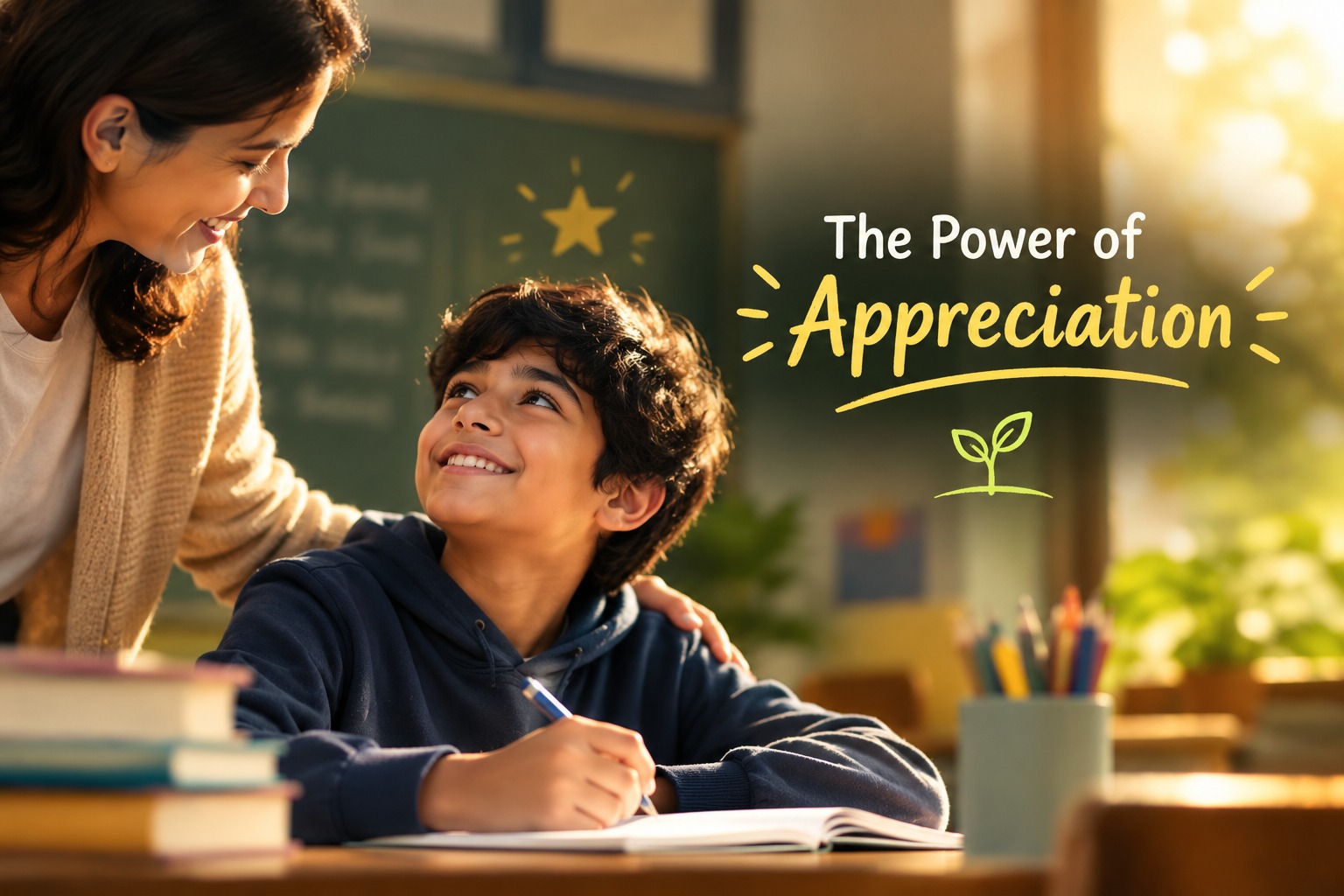
Every child wants to feel valued, heard, and appreciated. While academic performance is often measured through marks and grades, a child’s development goes far beyond examination results. The encouragement children receive from teachers and parents can have a lasting impact on their confidence, motivation, and attitude toward learning.
Positive feedback is one of the simplest yet most effective ways to encourage students. When children know that their efforts are noticed and appreciated, they are more willing to participate, take on challenges, learn from mistakes, and keep improving.
Why Appreciation Matters in a Child’s Education
Appreciation gives students a sense of accomplishment. Even a small acknowledgement such as “You worked hard on this” or “I can see how much you have improved” can motivate a child to continue putting in effort.
When students feel that their efforts matter, they are more likely to develop a positive attitude toward learning. Appreciation also helps create a classroom environment where students feel comfortable expressing their ideas and trying new things.
Appreciation Builds Confidence
Confidence plays an important role in a child’s academic and personal development. Students who believe in their abilities are more likely to participate in classroom activities, ask questions, and take initiative.
Positive feedback can help students recognize their own strengths. Instead of focusing only on what they need to improve, they also learn to understand what they are already doing well.
For example, appreciating a student for confidently presenting an idea in front of the class can encourage them to participate more actively in future activities.
Effort Matters as Much as Achievement
One of the most valuable forms of appreciation is recognizing effort.
Instead of praising only high marks or winning a competition, teachers and parents can acknowledge qualities such as persistence, preparation, creativity, discipline, and improvement.
Statements like:
“You worked really hard on this project.”
“Your presentation has improved a lot.”
“I liked the way you tried a different approach.”
“You did not give up when the task became difficult.”
help children understand that progress comes through consistent effort.
Positive Feedback Encourages a Growth Mindset
Children may sometimes believe that they are either “good” or “bad” at a particular subject or activity. Positive and constructive feedback can help them develop a growth mindset—the understanding that abilities can improve through learning, practice, and perseverance.
When a child makes a mistake, saying “Let’s see what we can learn from this” can be more helpful than simply pointing out the error.
This approach teaches students that mistakes are not the end of learning. Instead, they can become opportunities to understand, improve, and try again.
The Role of Teachers in Positive Reinforcement
Teachers play an important role in creating a positive learning environment. A teacher’s words can influence how students perceive themselves and their abilities.
Effective appreciation does not necessarily mean praising every action. Instead, it should be meaningful, specific, and genuine.
For example, rather than simply saying “Good job,” a teacher might say, “Your explanation was clear, and you supported your answer with a good example.”
Such feedback tells students exactly what they did well and encourages them to repeat positive behaviours.
Parents Also Have an Important Role
The impact of appreciation becomes stronger when parents and teachers work together.
Parents can encourage children by celebrating their progress rather than constantly comparing them with others. Every child develops at a different pace, and recognizing individual progress can help children stay motivated.
Parents can appreciate everyday achievements such as completing homework independently, helping a sibling, reading regularly, improving handwriting, or showing responsibility.
Appreciation Should Not Become Comparison
Healthy appreciation focuses on a child’s individual journey. Comparing one child with another can sometimes create unnecessary pressure and reduce confidence.
Instead of saying, “Why can't you score like your classmate?” parents and teachers can focus on personal improvement:
“What can we do to help you improve your performance?”
This shifts the focus from comparison to growth.
Creating a Culture of Appreciation at School
A positive school environment encourages students to appreciate not only their own achievements but also the efforts of their classmates.
Simple practices such as recognizing creativity, teamwork, helpfulness, leadership, improvement, and participation can make students feel valued.
When appreciation becomes part of everyday school culture, students can learn important values such as empathy, encouragement, respect, and teamwork.
Appreciation Can Shape Future Learners
Children who regularly receive meaningful encouragement can become more willing to face challenges and learn from setbacks. They begin to understand that success is not always about being the best—it is also about making progress and becoming better than before.
This mindset can benefit students not only during their school years but also in higher education, careers, and everyday life.
Conclusion
Appreciation may seem like a small gesture, but its impact on a child can be significant. Positive feedback can strengthen confidence, encourage effort, support a growth mindset, and create a healthier approach to learning.
At SRS Global School, we believe that every child has unique strengths, abilities, and potential. By creating an encouraging learning environment and recognizing students for their efforts and progress, schools can help children grow into confident, responsible, and lifelong learners.
Because sometimes, a few encouraging words can be the beginning of a child believing in themselves.