Education is evolving rapidly as technology continues to transform the way we live, work, and solve problems. In this changing world, students need more than textbook knowledge. They need practical skills, creativity, curiosity, and the ability to think critically.
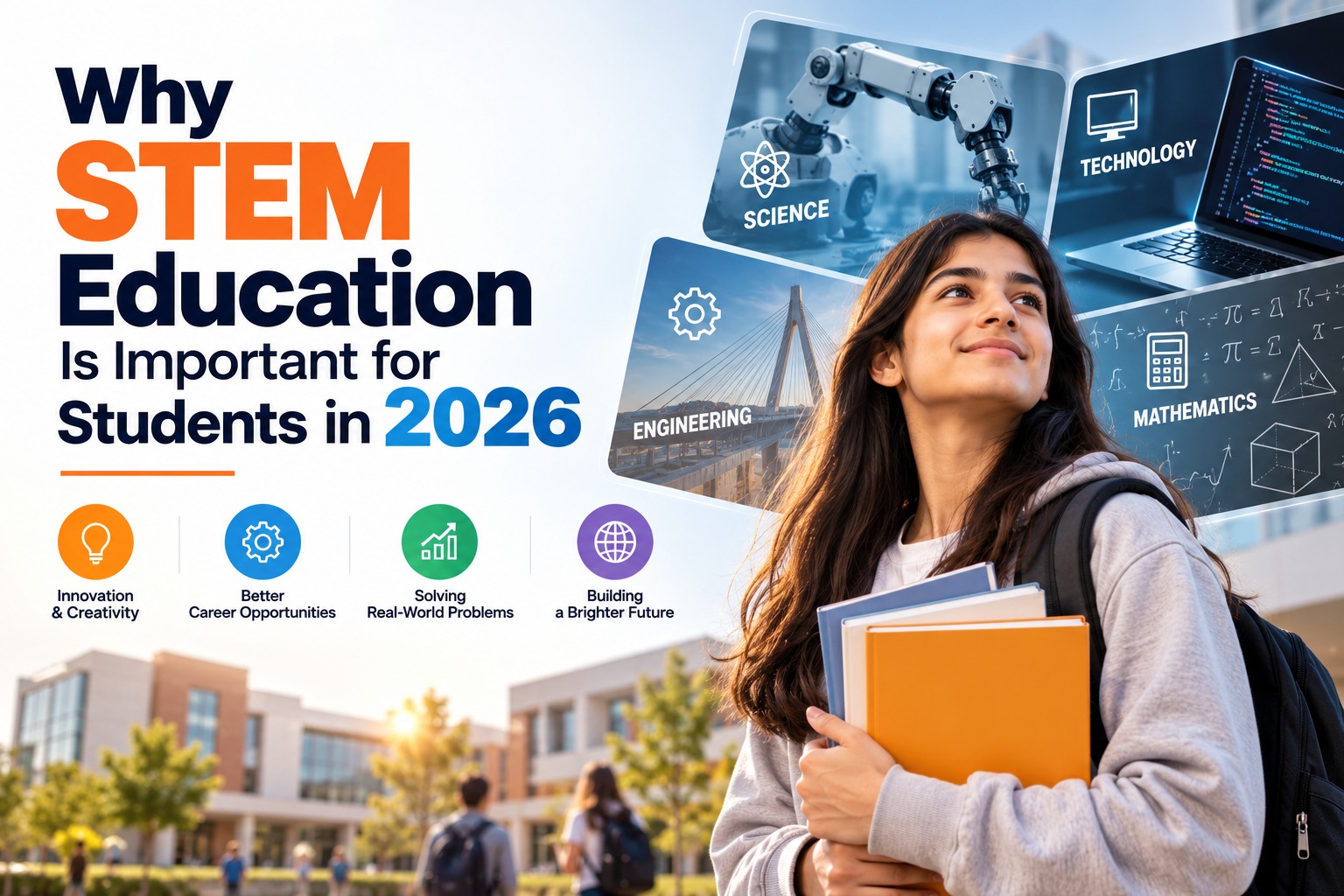
This is where STEM education plays an important role. STEM stands for Science, Technology, Engineering, and Mathematics. It combines these subjects to help students understand real-world challenges and develop practical solutions.
For schools like SRS Global School, STEM education is a relevant topic for exploring how modern learning can prepare students for a technology-driven future.
What Is STEM Education?
STEM education is an interdisciplinary approach that connects science, technology, engineering, and mathematics through practical learning experiences.
Instead of studying every subject in isolation, students explore how different concepts work together in real life.
For example, building a simple bridge model can help students understand engineering principles, mathematical measurements, scientific concepts, and the importance of testing their ideas.
This approach encourages students to ask questions, experiment, analyse results, and learn from their mistakes.
1. Develops Critical Thinking and Problem-Solving Skills
One of the biggest benefits of STEM education is that it encourages students to think independently.
When students work on experiments, puzzles, coding exercises, or engineering challenges, they learn to identify problems and explore possible solutions.
These activities help students develop logical reasoning, decision-making, and analytical thinking.
Such skills are valuable not only in academic life but also in everyday situations where students must evaluate information and make informed decisions.
2. Encourages Creativity and Innovation
STEM education is not limited to formulas and technical knowledge. It also provides opportunities for creativity and innovation.
Students may design a model, develop a simple application, build a robotic device, or create a solution to an environmental problem.
These activities encourage them to think beyond conventional answers and explore different approaches.
When students are given opportunities to experiment and share their ideas, they become more confident in their ability to create and innovate.
3. Makes Learning More Practical and Engaging
Practical activities can make complex concepts easier to understand.
For instance, a science experiment can demonstrate a principle that may otherwise seem abstract in a textbook. Similarly, a coding activity can help students understand logic, sequencing, and problem-solving.
Hands-on learning connects classroom knowledge with real-world applications.
Projects, demonstrations, experiments, and group activities can also make lessons more interactive and memorable.
4. Builds Digital Literacy and Technology Awareness
Technology has become an essential part of modern life. Understanding how digital tools work helps students use technology more effectively and responsibly.
STEM learning can introduce students to coding, robotics, digital design, data analysis, and basic computer science concepts.
Students can also learn about responsible technology use, online safety, and the importance of evaluating digital information.
Developing digital literacy at an early stage can help students become more confident learners in an increasingly connected world.
5. Prepares Students for Future Career Opportunities
Many industries use scientific knowledge, technology, engineering principles, and mathematical reasoning to develop products and solve problems.
STEM education can introduce students to a wide range of future career paths, including:
Software development
Engineering
Data science
Robotics
Artificial intelligence
Environmental science
Healthcare technology
Scientific research
However, STEM education is valuable even for students who do not choose technical careers. Analytical thinking, communication, collaboration, and problem-solving are useful across many professions.
6. Promotes Teamwork and Collaboration
Many STEM projects involve working in groups. Students may need to plan a project, divide responsibilities, exchange ideas, and evaluate the results together.
These experiences teach them how to listen to others, communicate clearly, resolve disagreements, and work toward a shared goal.
Team-based activities also help students understand that different perspectives can contribute to better solutions.
Collaboration is an important life skill that supports both academic success and personal development.
7. Encourages Environmental Awareness
STEM education can help students understand environmental challenges and explore sustainable solutions.
Activities such as creating a water filtration model, studying renewable energy, designing a rainwater harvesting system, or measuring classroom energy use can connect science and mathematics with environmental responsibility.
Through such projects, students can learn about conservation, climate awareness, waste management, and sustainable living.
This helps them understand how scientific knowledge can contribute to a healthier planet.
8. How Parents Can Encourage STEM Learning at Home
Parents can support STEM learning through simple everyday activities without requiring expensive equipment.
Here are a few practical ideas:
Try simple science experiments: Explore safe experiments using common household materials.
Encourage building activities: Use building blocks or recycled materials to create models.
Introduce basic coding: Explore age-appropriate coding games and beginner programming platforms.
Use mathematics in daily life: Involve children in measuring ingredients, comparing prices, or calculating distances.
Ask open-ended questions: Encourage children to explain how something works and suggest possible solutions.
Celebrate curiosity: Allow children to experiment, make mistakes, and learn from the process.
The goal is to make learning enjoyable and encourage children to explore how the world works.
9. The Role of Schools in Promoting STEM Education
Schools can support STEM learning by creating opportunities for students to apply their knowledge in practical situations.
Science experiments, mathematics activities, coding sessions, robotics projects, design challenges, and collaborative assignments can help students explore STEM concepts.
Teachers can also connect classroom lessons with real-world examples and encourage students to ask questions rather than simply memorise information.
An effective STEM learning environment should be inclusive and age-appropriate, giving students with different interests and abilities opportunities to participate.
For SRS Global School, STEM education can be an engaging subject for discussing the value of curiosity, practical learning, innovation, and future-ready skills.
Parents interested in STEM opportunities should explore the school's verified curriculum details, available facilities, and relevant learning activities.
Conclusion
STEM education is an important part of preparing students for a world shaped by science, technology, and innovation. By connecting classroom knowledge with practical experiences, it can help students develop critical thinking, creativity, collaboration, and problem-solving skills.
These abilities support students in their academic journey and prepare them to explore a wide range of future opportunities.
Whether through a simple science experiment, a coding exercise, or a collaborative engineering project, every STEM learning experience can encourage children to ask questions, explore ideas, and discover new possibilities.
At SRS Global School, inspiring curiosity and encouraging a love for learning are valuable themes in every conversation about a child's educational journey.
Note: Verify any school-specific STEM programmes, laboratories, facilities, and activities before publishing claims about them.